Advanced packaging moves to the center of system innovation
At ECTC 2026, advances in heterogeneous integration, hybrid bonding, advanced substrates, photonic packaging, and thermal management underscored a fundamental shift in semiconductor innovation, one where system performance is increasingly defined by packaging and integration technologies rather than transistor scaling alone.
By Sarab Chopra, Editor, Advanced Packaging Magazine
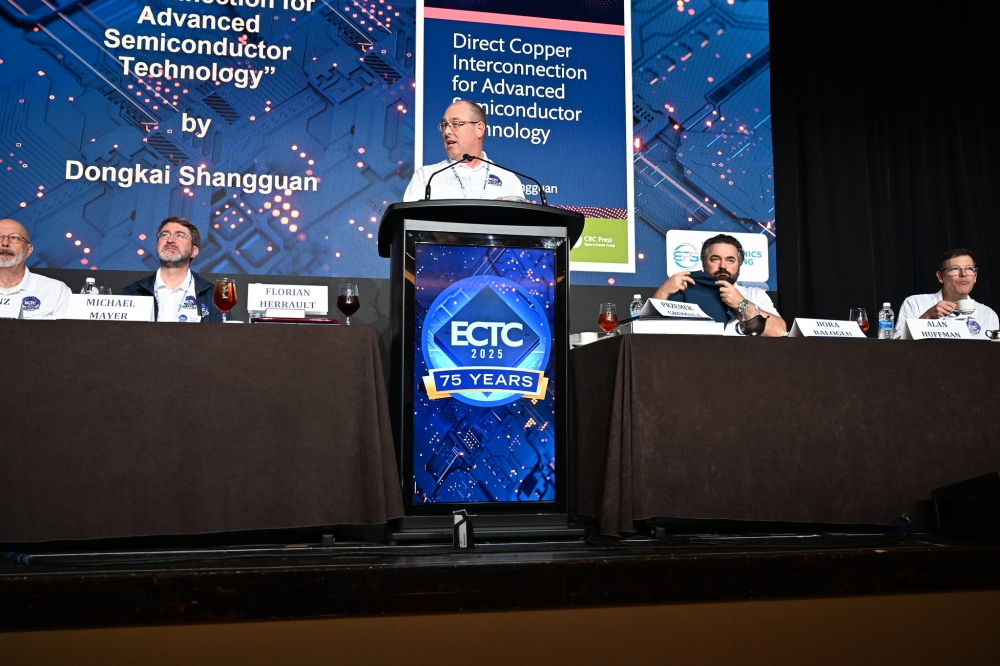
The 76th IEEE Electronic Components and Technology Conference (ECTC 2026), held in Orlando, Florida, once again provided a key global forum for advances in semiconductor packaging, heterogeneous integration, and system-level integration technologies.
The conference brought together researchers, engineers, and industry stakeholders across the semiconductor ecosystem, with technical sessions spanning advanced interconnects, substrate technologies, thermal management, power delivery, photonics integration, and reliability engineering. This year’s program reflected the continued acceleration of system complexity driven largely by artificial intelligence (AI), high-performance computing (HPC), and data-centric applications.
A consistent theme across the technical program was the increasing role of advanced packaging as a system enabler rather than a downstream integration step. As transistor scaling faces increasing physical and economic limitations, innovation is shifting toward package-level architectures that integrate multiple dies, functions, and materials into unified systems.
Heterogeneous Integration and AI-Driven Requirements
Heterogeneous integration remained central to many presentations at ECTC 2026, reflecting the industry’s response to growing AI workload demands. Increasing memory bandwidth requirements, rising data movement energy costs, and thermal constraints are driving the adoption of multi-die architectures combining logic, memory, analog, and emerging photonic components within single packages.

A representative contribution in this area explored fan-out panel-level packaging (FOPLP) approaches for HPC and AI applications. The work demonstrated a 600 mm panel interposer flow subsequently partitioned into 300 mm sub-panels, enabling compatibility with existing assembly infrastructure while improving manufacturing throughput. The study highlighted key process challenges including warpage control, layer-to-layer alignment, and uniformity in redistribution layer (RDL) fabrication at large panel scales. The results indicated that panel-level integration can support higher interconnect density and improved cost efficiency, while maintaining reliability through optimized process partitioning and laser-based singulation techniques.
Across multiple sessions, it was evident that system design methodologies are also evolving, with package-level considerations increasingly incorporated earlier in the design cycle through closer collaboration between chip designers, package architects, and system engineers.
Hybrid Bonding Advances Toward Manufacturing Readiness
Hybrid bonding continued to be a major focus area, with discussions shifting further toward manufacturing implementation rather than feasibility.
Recent developments highlighted progress in alignment accuracy, defect control, surface preparation, and metrology techniques. This reflects the technology’s transition from research demonstration toward early-stage high-volume manufacturing readiness.
A related study on chip-to-wafer hybrid bonding with inter-die gap fill integration (IDGF) demonstrated a process flow enabling 3D stacking while managing critical reliability risks. The work focused on void formation, wafer thinning challenges, and delamination mechanisms during multi-stack integration. Simulation and experimental validation showed that optimized gap-fill materials and process sequencing can significantly improve structural stability while enabling higher stacking densities.
These developments are particularly relevant for AI-driven architectures where bandwidth density and vertical integration are increasingly critical.
Power Delivery and Thermal Constraints
Power delivery was widely discussed as an increasingly critical constraint in advanced system design. AI and HPC devices are now operating at power densities that place significant demands on package-level electrical infrastructure.
Sessions addressing power distribution networks, voltage regulation strategies, and low-impedance package designs emphasized the importance of minimizing resistive losses and improving current delivery efficiency. Power delivery is increasingly being treated as a first-order design parameter rather than an afterthought
Thermal management is similarly becoming a key limiting factor. With rising heat flux in advanced devices, conference presentations highlighted continued progress in liquid cooling approaches, advanced thermal interface materials, vapor chambers, and embedded cooling techniques. Importantly, thermal considerations are now being integrated into early-stage architectural planning alongside electrical and mechanical design.
Substrate Innovation and Glass-Based Approaches
Substrate technology remains a critical area of innovation as package sizes grow and interconnect density increases. Traditional organic substrates are facing challenges related to warpage control, dimensional stability, and routing density.
Glass substrates were a notable area of interest at ECTC 2026, with multiple presentations focusing on manufacturing techniques, through-glass vias, metallization processes, and reliability characterization. While still emerging, glass-based substrates are increasingly viewed as a potential solution for next-generation high-density packaging platforms due to their mechanical stability and electrical performance advantages.
Photonic Integration and Co-Packaged Optics
Another key theme at ECTC 2026 was the growing role of photonic integration in addressing data movement bottlenecks. As system bandwidth requirements increase, electrical interconnects face limitations in both energy efficiency and scaling potential.
Co-packaged optics and photonic integration technologies were discussed with increasing emphasis on manufacturability, reliability, and system integration challenges. The focus is shifting from conceptual demonstrations toward practical deployment pathways, particularly in data center and AI infrastructure applications.
Manufacturing, Reliability, and Modeling
Across the conference, there was strong emphasis on manufacturability and reliability as enabling factors for emerging technologies. Topics included warpage modeling, defect detection, thermomechanical reliability, and advanced material characterization.
One fault isolation study in advanced fan-out RDL interconnect systems highlighted the growing difficulty of identifying nanometer-scale defects in dense redistribution networks. The work demonstrated that conventional inspection methods, such as 3D X-ray and focused ion beam analysis, face significant limitations in large-scale interconnect architectures. The proposed fault localization approach improves failure identification efficiency, supporting faster diagnosis in high-density AI packages.

Predictive modeling techniques, including multiphysics simulation and digital twin approaches, are becoming increasingly important in bridging the gap between design and production. These tools are enabling earlier identification of potential failure mechanisms and improving development efficiency for complex package architectures.
Conclusion
ECTC 2026 highlighted a semiconductor industry undergoing a clear structural shift toward system-level innovation. As traditional scaling approaches face increasing constraints, advanced packaging is becoming a central platform for integrating heterogeneous technologies into high-performance systems.
Technologies such as hybrid bonding, advanced substrates, co-packaged optics, panel-level fan-out integration, and integrated power and thermal solutions are no longer peripheral areas of research. They are now central to enabling the next generation of AI, HPC, and data-intensive applications.
The overall direction emerging from the conference is clear: future semiconductor performance gains will depend not only on transistor innovation, but increasingly on how effectively diverse technologies are integrated at the package and system level.