
Advanced packaging at the limit: Where wet chemical precision meets cost-efficiency
As advanced packaging pushes redistribution layer (RDL) geometries to sub-micron limits, manufacturers must balance extreme process precision with the economic realities of high-volume production. Innovations in wet chemical processing and batch spray technologies are emerging as critical enablers for achieving both yield reliability and cost-efficient advanced packaging at scale.
Bernhard Hammerl, Business Development, Siconnex
The semiconductor industry is going through a massive shift. For decades, Moore’s Law relied almost entirely on front-end scaling – the relentless push to shrink transistor nodes. But as we get closer to the physical limits of silicon atoms and face the massive costs of High-NA EUV (Extreme Ultraviolet) lithography, shrinking things at the transistor level is simply getting too expensive.
The real action, and the biggest driver of performance gains, has decisively shifted to Advanced Packaging. Concepts that used to be considered experimental niches – like Fan-Out Wafer Level Packaging (FOWLP), 2.5D silicon interposers, and true 3D heterogeneous stacking (chiplets) – are now the go-to standard for high-performance computing (HPC), artificial intelligence (AI) accelerators, and top-tier mobile processors.
But this new era of system-level integration comes with a catch: it demands the kind of strict precision, cleanliness, and defect control we used to only see in front-end-of-line (FEOL) manufacturing.
Redistribution Layers (RDLs): The critical highway
At the heart of these advanced setups are Redistribution Layers (RDLs). As die sizes shrink and input/output (I/O) pin counts go through the roof, finding the physical space to route signals off the chip becomes a massive bottleneck. RDLs act as microscopic highways that connect the tiny, high-density bumps on the silicon die to the larger pads on the package substrate.

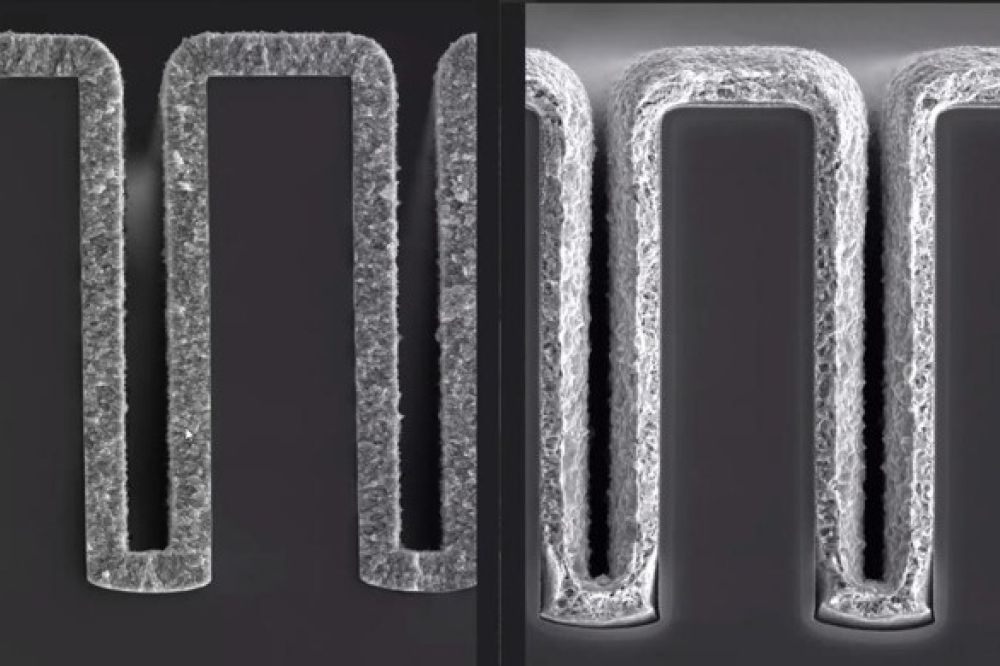
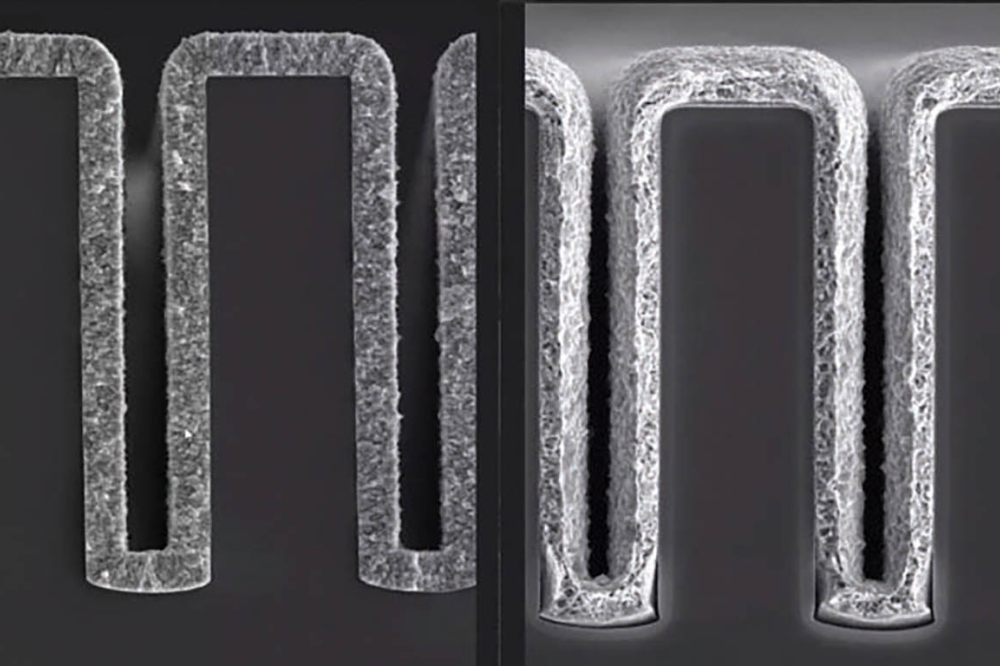
A cross-section of an RDL stack showing the dielectric, barrier layer, seed layer and electroplated copper to visualize the structural complexity.Photo Credit: Siconnex
And this is exactly where things get tricky, especially when you are working with standard 12-inch (300mm) wafers and the strict demands of copper.
The Copper Dilemma: Why RDLs are so demanding
Copper is still the undisputed gold standard for RDL metallization. Compared to older aluminum tech, copper gives you much better electrical conductivity and holds up a lot better against electromigration. This is key to keeping the Resistance-Capacitance delay (RC) low, which dictates how fast electrical signals can travel through the interconnects.
But working with copper at the packaging level gives integration engineers a really tough checklist:
- Aggressive Scaling: We are talking extremely tight line/space (L/S) resolution (often pushing sub-2µm in advanced nodes) while keeping the geometric shapes absolutely perfect.
- Electrical & Mechanical Integrity: You need low electrical resistance combined with a strong mechanical grip to various organic and inorganic dielectrics (like polyimide or silicon nitride).
- Yield Reliability: The process needs to be rock-solid and repeatable, ensuring the thousandth wafer turns out exactly like the first.
The main issue is that these high-end demands often clash hard with manufacturing realities. Moving from the additive process of electroplating to the subtractive wet chemical removal of excess layers is a major bottleneck. This is the make-or-break moment that decides if a highly valuable, nearly finished wafer turns into functional chips or just becomes expensive scrap.
The Standard Semi-Additive Process (SAP) flow and its pitfalls
To understand the holdup, let’s look at the classic Semi-Additive Process (SAP) workflow used for copper RDLs:
- PVD (Physical Vapor Deposition): A blanket barrier layer (usually Titanium or Titanium Tungsten, Ti/TiW) is sputtered onto the wafer to stop copper from bleeding into the dielectric. A thin copper seed layer goes on right after.
- Lithography: A thick photoresist is applied, exposed, and developed to map out the exact negative patterns of the interconnects.
- Electroplating (ECD): Copper is electrochemically grown inside the resist of trenches to build the actual structural lines and vias.
- Wet Chemical Etch: This critical final stage requires extreme precision to remove the redundant metal. The resist is stripped, followed by a wet-etch of the exposed copper seed layer and the underlying Ti/TiW barrier layer.

Photo Credit: Siconnex
These final wet chemical steps are the main reason for yield loss. The chemicals need to be aggressive enough to fully clear the seed and barrier layers, but gentle enough not to eat away the plated copper lines.
- Under-etching: Leaves behind metallic leftovers, which causes electrical shorts between adjacent lines.
- Over-etching: Leads to galvanic corrosion or structural undercut beneath the copper lines. This causes a loss of critical dimension (CD), mechanical weakness, and eventually, a failed device.
The agony of choice: Wet bench, single wafer, or batch spray?
When setting up a fab for these critical wet etch steps, process engineers hit a technological crossroad. There are three main ways to get the chemistry onto the wafer, and they all have different physical and economic trade-offs.
The Classic: Automated wet bench
Wet benches submerge entire cassettes of wafers into static or circulating chemical baths. They are relatively cheap and offer the highest throughput of all available technologies by processing large batches simultaneously. However, for fine-pitch RDLs, the fluid dynamics are often inadequate. The chemical mix in a bath is too static, leading to serious non-uniformity across the wafer, particularly centre-to-edge variations.
Furthermore, wafers frequently drag contaminants from one bath to the next, increasing the risk of defects. While the large footprint of these systems is manageable if floor space is not a constraint, the high chemical consumption remains a significant drawback. Ultimately, for sub-2μm RDLs, the etch precision of a wet bench is insufficient to meet modern integration requirements.
The Sprinter: Single wafer spin process
In this technology, each wafer is processed one by one inside a closed chamber. The wafer spins on a chuck while nozzles spray fresh chemistry right onto the surface. This gives you excellent within-wafer (WIW) uniformity. However, the economics are prohibitive. It suffers from low throughput, takes up a massive footprint on the fab floor (due to the low productivity-per-square-meter), and burns through chemistry because it is a “single-pass” (straight to the drain) system.
The Hybrid Solution: Batch spray technology
This is where innovative designs are shaking up the market. The engineering concept is elegant: it combines the high-precision uniformity of a rotational spray process with the high-throughput economics of a batch tool, processing up to 50 wafers simultaneously. Beyond its impressive performance, this approach offers a compact footprint and significantly lower chemical consumption, making it a highly sustainable and cost-effective solution.

Comparing Single Wafer, Wet Bench and Batch Spray technologies. Photo Credit: Siconnex
How batch spray offers the “best of both worlds”
Siconnex targets exactly this technical and economic sweet spot. But what happens physically inside the process chamber to allow batch processing to rival single-wafer precision?
Fluid Mechanics: Rotational dynamics meets spray power
Unlike the static immersion of wet benches, wafers in the Siconnex BATCHSPRAY® system are placed in a rotor inside a sealed chamber. As the rotor spins, an array of precisely calibrated nozzles actively sprays the chemistry onto the wafers.
This relies on advanced fluid mechanics. The rotation speed (RPM) and spray pressure are actively thin and control the hydrodynamic boundary layer on the wafer surface. Perfectly synchronised rotation and spray speeds create a homogeneous, constantly renewing liquid film. This physical agitation ensures that reaction byproducts are instantly swept away, preventing localised chemical depletion at the surface. The result is an etch rate non-uniformity of less than 3% across a 300mm wafer – rivalling the best single-wafer tools but achieving much higher throughput.
Ecology and Economy: Closed-loop recirculation
While burning through chemicals and managing waste are significant challenges for single-wafer systems, batch spray architectures fix this with closed-loop recirculation. Instead of flushing expensive, toxic chemistry to the fab’s waste treatment plant, the etchant is continuously collected, filtered for particles, dynamically temperature-controlled, and reused. This closed-loop process locks in the absolute thermal and chemical stability you need for repeatable etch rates on fine-pitch RDLs. Beyond technical stability, this approach slashes consumable costs and massively shrinks the fab’s environmental footprint – a crucial metric for modern Environmental, Social, and Governance (ESG) reporting.
Process Integration: Merging the toughest steps into one platform
In the high-stakes world of advanced semiconductor manufacturing, having great fluid dynamics and chemical efficiency is only half the battle. Process integration is fast becoming the ultimate differentiator. By combining photoresist stripping, copper seed etching, and barrier material etching in a single equipment platform, fabs don’t just save floor space – they drastically cut down handling complexity, boost process stability, and reduce costs.
Siconnex tackles this head-on with its BATCHSPRAY® platform, a highly customizable wet processing system designed to streamline these advanced backend applications. The core of this system’s efficiency lies in its four independently recirculating chemical tanks. Each loop operates as a fully functional process module, enabling the management of four distinct concentrated chemistries within a single tool. This integrated architecture facilitates the seamless execution of critical Semi-Additive Process steps:
- Photoresist stripping
- Copper seed layer etching
- Barrier material etching
Each tank loop packs its own heater to dial in precise temperatures for optimized reaction kinetics. Integrated filtration systems keep the chemistry pure and particle-free – an absolute must for high-yield processing. Plus, optional inline concentration monitoring gives you real-time control over the chemical makeup, ensuring stable, repeatable results in High-Volume Manufacturing (HVM).
This modular, independent tank design takes
the operational drawback out of chemical management while maxing out flexibility. Engineers can tweak parameters for each chemistry individually without sacrificing uniformity or throughput. With the demand for heterogeneous integration exploding, packing multiple wet processes into one configurable platform is a massive advantage.
The Yield Safety Net: In-Situ endpoint detection (EPD)
Process engineering operates on a simple truth: no previous process step is ever truly perfect. Sputtered seed layers and barriers will naturally vary in thickness across a wafer and from batch to batch. Blindly etching based on a set timer creates a big risk of over-etching or under-etching. Modern batch spray systems get around this by using in-situ Endpoint Detection (EPD). Using advanced optical sensors, the system can literally “see” the exact moment the copper seed is cleared, and the underlying barrier layer is exposed. By actively stopping the process at exactly the right moment, the etch step repeatability becomes incredibly robust. It absorbs upstream variances from lithography or deposition without sacrificing yield.
Scalability is the ultimate metric
As fabs scale their Advanced Packaging lines from pilot R&D to High-Volume Manufacturing, the physical footprint of equipment often becomes a major strategic roadblock. Cleanroom floor space
is among the most expensive real estate on the planet.
Therefore, density is as critical as throughput. A standalone batch spray system occupies only a fraction of the floor space compared to an equivalent lineup of single-wafer tools. This compact footprint enables seamless capacity expansion within existing cleanroom boundaries, effectively bypassing the need for massive capital expenditures on costly facility extensions.
As geometric and electrical demands push copper RDLs to their limits, staying competitive requires fabs to master the exact intersection of wet chemical precision and cost-efficiency. When looking for a solution that secures both high-yield performance and overall profitability, integrated batch spray solutions offer a proven, physics-based approach that delivers the ideal balance.
By bridging the gap between the high cost of single-wafer processing and the inherent footprint challenges of wet benches, this architecture provides a versatile workhorse capable of meeting modern RDL requirements without compromising on economic efficiency.