
Targeting semiconductor packaging pain points with multiphysics simulation
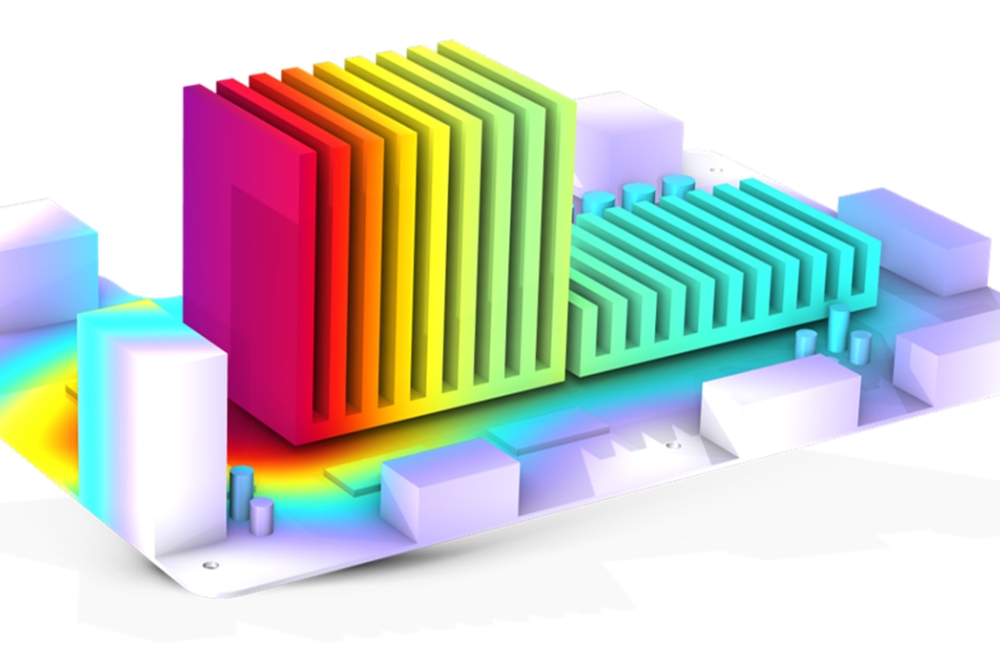
Multiphysics simulation can be used in semiconductor packaging to predict performance and ensure packaging reliability. This article goes over the areas of packaging where simulation can improve R&D
By Andy Cai, COMSOL, Inc.
The perpetual drive to shrink semiconductor components means ever-increasing complexity — the need for denser integration, tighter thermal margins, and stricter reliability requirements has become more severe. In advanced packaging, especially for emerging 3D chip architectures, this complexity is amplified by vertical stacking, high-density interconnects, and diverse material interfaces. Challenges like warpage, interconnect fatigue, and thermal stress aren’t isolated issues; they’re tightly coupled and difficult to manage through testing alone. Modeling and simulation has become more common in packaging for addressing such challenges. However, even with the growing adoption of simulation, there remains a general hesitancy to fully embrace it.
It’s true that parameters like material behavior carry uncertainty, so numerical models must rely on additional physics assumptions and simplifications. It’s also true that no model can capture every detail of the physical world, but the goal of simulation isn’t to mirror reality perfectly. Simulation is meant to help teams address design challenges and gather critical insight that can guide development decisions. When built thoughtfully, models can reveal dominant effects and clarify cause-and-effect relationships.
Multiphysics simulation is particularly powerful in semiconductor packaging, where coupled effects (e.g., thermal, mechanical, and sometimes electrical effects) drive system performance and reliability. Moreover, simulation complements testing (rather than replacing it), helping teams reduce iteration cycles and make better decisions with fewer surprises.
Packaging Process Simulation
Multiphysics simulation has made a difference in various areas of semiconductor packaging. Below, we highlight some of these application areas.
Wet and Dry Etching
Both wet and dry etching are essential for the creation of features in advanced packaging, and both processes can be simulated accurately despite their complexities.
When simulating wet etching, chemical reactions as well as mass transport need to be considered. The interaction between fluid transport, diffusion, and reaction kinetics can be simulated and optimized to ensure etch uniformity or minimal undercutting. Conversely, dry etching can require significantly more complex physics couplings, as it involves plasma chemistry, ion transport, and directionally dependent material removal. Regardless, the right tools will enable you to model this process accurately.
Figure 1 shows an example of anisotropic wet etching of silicon, based on the different etching rates of silicon’s crystal planes in a KOH solution. In the model, a small initial groove on the wafer surface comes into contact with the KOH solution, and pyramid-shaped grooves gradually form over time due to the crystal-plane–dependent chemical etching reaction.

Figure 1. The development of an etched groove shape over time due to wet etching
Soldering Process
Solder joints and the reflow process used to create them are crucial in semiconductor packaging but can also be sources of significant reliability challenges, including thermal fatigue and warpage. To give one example, warping of a die from internal stresses can build up during the reflow process (Figure 2) and adversely affect a component’s performance or cause early failure.

Figure 2. Warpage in a semiconductor after reflow soldering
The melting and solidification behavior typical in the soldering process is often hard to predict, but it can be accurately simulated to provide insight into how thermal loads will evolve and how stress will develop as materials transition from liquid to solid. Multiphysics modeling can replicate the metallurgical phase transitions and the residual stress state with multiple metal phase transformations. These visualizations can offer insight into the mechanical reliability of the solder joints and the operating conditions in which they will succeed. Solder joints are typically modeled with temperature- and rate-dependent viscoplastic (creep) constitutive laws, since stresses evolve during reflow and thermal cycling. Elastic–plastic and fatigue/damage models are added as needed to capture irreversible deformation and predict life.
Underfill
Underfill adhesives often exhibit non-Newtonian flow behavior, requiring rheological models and temperature-dependent properties. When these adhesives cure, they create residual stress and warpage. To get a complete understanding of underfill phenomena, it’s best to use a multiphysics approach to assess both the chemical kinetics of the curing process and the resulting mechanical deformation within the same simulation space.
Grinding, Dicing, and Molding
Mechanical operations in semiconductor packaging usually involve grinding, dicing, and molding (Figure 3). While these are routine steps, they introduce stresses and carry a risk of cracking in the packaged product. In particular, the risk of cracking is highest near edges and interfaces. Multiphysics simulation can be used to assess the impact of cutting forces and thermal effects on structural integrity.

Figure 3. Warpage evolution during the epoxy molding compound (EMC) molding process
Package Reliability Simulation
When testing package reliability, it’s critical to consider environmental factors such as ambient humidity and moisture ingress through diffusion into materials. Let’s talk about the areas where multiphysics simulation can play a role in ensuring packaging reliability.
Humidity and Moisture Ingress
The presence of moisture has damaging consequences: hygroscopic swelling, corrosion, and delamination risks. A multiphysics approach supports coupled heat- and moisture-transfer (hygro-thermal) modeling, allowing users to simulate moisture, ingress over time, and AC interactions with temperature and mechanical stress. This modeling is particularly useful for predicting failure during preconditioning or accelerated life testing, as it can reduce the amount of prototyping and testing.
Structural Damage and Failure
When things go wrong, multiphysics simulation can be used for detailed failure analysis. Whether the failure is due to interfacial delamination, crack initiation and growth, or even thermal fatigue of solder joints, there are methods for virtually assessing what went wrong and how it can be prevented. Users can create models that include fracture mechanics for crack risk estimation as well as simulate progressive crack growth. In Figure 4, you can see a stress singularity at the crack tip in a sample plate geometry.

Figure 4. A geometry showing the von Mises stress and the deformed shape of a cracked plate. Note that the displacement is exaggerated to illustrate the deformation under the applied load.
Shock, Vibration, and Static Loads
When modeling semiconductor packaging, it is important to account for mechanical shock and vibration and evaluate how these loading conditions affect package reliability. Models can be used to analyze the vertical displacement of a motherboard from a response spectrum evaluation, as shown in Figure 5. This need is especially heightened for mobile or automotive applications where semiconductor packages must withstand various dynamic stresses.

Figure 5. A motherboard’s vertical displacement as a result of a response spectrum evaluation
Users can perform a variety of dynamic mechanical analyses, including frequency-domain studies, impact simulations, response spectrum evaluations, and random vibration modeling. Similar approaches can be applied to assess package response to static mechanical stresses, such as bending, torsion, or compression. These evaluations support design validation for a range of scenarios, such as a four-point bending test.
Thermal Management in Packaging
Thermal management is a multiphysics process that requires thermoelectromechanical simulation and CFD simulation. In advanced packaging specifically, these models require significant computational resources for computation. This is particularly true when working with 3D stacked layers or, in general, when including designs with a large number of components.
Simulation users benefit by coupling the three primary heat transfer modes in the same model: conduction, convection, and radiation. This coupling gives users the option to decipher the individual impact on different pieces of the overall system. For example, for a device in a package with air gaps, heat sinks, and a surrounding enclosure, users may want to include all three heat transfer modes but find that only one or two of the mechanisms will be the dominant dissipation or heating mechanism. Simulation enables users to easily turn on and off each mechanism and test it until they have a better understanding of how each one impacts the results.
In electronic packages, heat sources often arise from electromagnetic loss mechanisms such as resistive (ohmic) heating, eddy current losses, or dielectric heating in RF components. Simulation can couple these electrical and magnetic effects with thermal and mechanical responses, incorporating temperature-dependent material properties for metals and substrates.
Electromagnetic Performance in Packaging
Electromagnetics simulation can be used to analyze how packaging affects signal propagation, including high-frequency effects such as skin and proximity effects. It can also evaluate how different geometries or materials influence transmission-line performance. This capability is valuable for predicting and mitigating signal integrity issues early in the design process, before hardware fabrication, to help rule out potential problems. A multiphysics approach enables coupling of detailed finite element (FEM) electromagnetic models with circuit-level simulations, supporting mixed-domain modeling in which part of the signal path is analyzed in full-wave detail while the remainder is represented by circuit elements. Users can automatically generate SPICE-compatible circuit models from extracted data and simulate signal reflections, losses, or noise to trace their origins to specific physical structures, which can be useful for both design and verification.
Bringing Simulation to the Factory Floor
Let’s switch gears and discuss a specific modeling tool and how it can spread the use of simulation throughout organizations.
Through simulation apps, models can be brought into the field or onto the factory floor. These custom-made simulation tools can present team members with the information most relevant to their work, as opposed to presenting a full software user interface or unrelated data. App users can easily modify input parameters and study the computational results, even if they don’t have foreknowledge of the underlying model or simulation software.
In semiconductor packaging, complex models can be compiled into apps and shared with team members who are not simulation experts. Figure 6 shows a thermoelectric cooler simulation app with a specialized interface that contains only the parameters needed for specific analysis cases. This type of app can be used to examine current and temperature distributions for different inputs, enabling critical analyses to be performed easily and without the help of a simulation expert.

Figure 6. A simulation app that enables users to analyze single-stage thermoelectric cooler designs by testing various geometries, thermocouple configurations, and materials
In this article, we have touched on common application areas within semiconductor packaging where multiphysics simulation can be used. Multiphysics is how the world works, and semiconductor packages are proof of this point. With devices only getting more complex, it’s only right that the tools we use to assess their design and operation have powerful, growing functionality.
Multiphysics simulation can help give R&D departments an understanding of where they need to move their design in tandem with their real-world experimentation.