TSMC expands packaging and U.S. operations

Taiwan Semiconductor Manufacturing Company (TSMC) is doubling down on advanced packaging and U.S. expansion as it positions itself for continued growth in high-performance computing (HPC) and AI chips.
For Q4 2025, TSMC reported revenue exceeding $33 billion, up more than 20% year-over-year, driven by demand for AI and HPC applications.
The company also announced a cash dividend of NT$6.0 per share for the quarter and outlined a 2026 capital expenditure budget of $52–56 billion to maintain technological leadership and expand capacity.
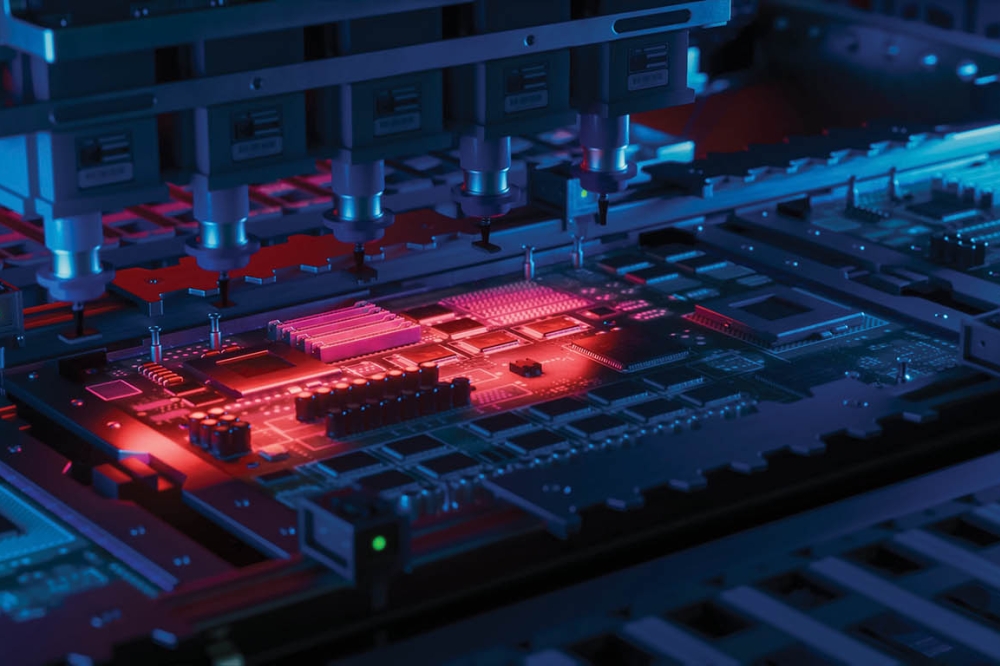
A critical focus is advanced packaging, particularly the Chip-on-Wafer-on-Substrate (CoWoS) technology. TSMC plans to ramp CoWoS capacity to 130,000 wafers per month by the end of 2026, nearly four times the capacity at the end of 2024.
The AP7 facility in Chiayi, Taiwan, will become the world’s largest advanced packaging site upon completion in 2027.
Parallel to its technological push, TSMC is pursuing U.S. manufacturing expansion, leveraging a proposed Taiwan-U.S. trade agreement that allows duty-free import of chips during plant construction.
TSMC is evaluating an additional $100 billion investment in the U.S., bringing total planned investment to $265 billion, including its ongoing Fab 21 complex in Arizona.
Despite international expansion, Taiwan remains TSMC’s manufacturing core. Up to 30% of chips produced on 2-nanometer and smaller nodes could eventually be made in the U.S., while Taiwan continues to handle the majority of leading-edge production.
Advanced technologies (7nm and smaller) accounted for 77% of wafer revenue in Q4 2025, highlighting TSMC’s focus on cutting-edge semiconductors.
Analysts note that success in ramping advanced packaging and executing U.S. expansion plans will be key to sustaining TSMC’s growth trajectory.